
 NepalTravel
Hundreds missing in Nepal and Tibet floods, including 341 foreign tourists
A flash flood and mudslide swept through valleys in Nepal and Tibet on 26 August 2026, killing dozens and leaving hundreds missing, among them hundreds of foreign travellers. Rescue helicopters could not land because floodwaters stayed high.
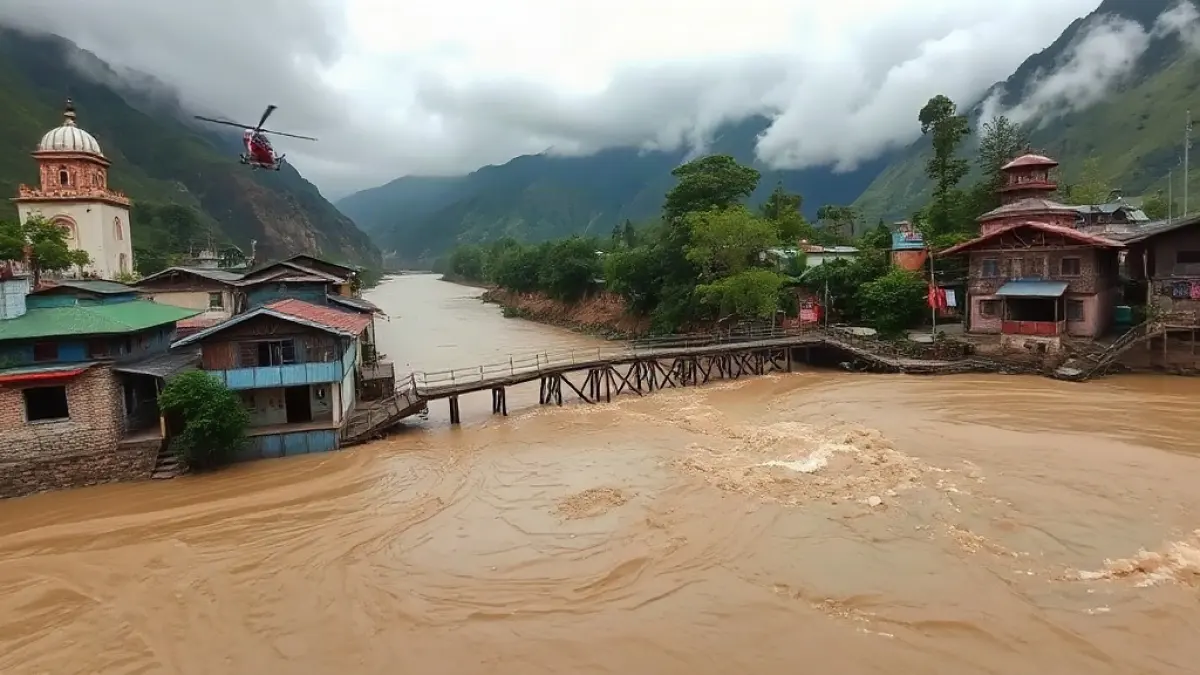
A flash flood that tore through remote valleys in Nepal and Tibet on 26 August 2026 has left dozens dead and hundreds of people missing, including hundreds of foreign travellers. Rescue helicopters sent to the affected areas were unable to land because floodwaters remained too high.
Key facts
- Nepali police said 157 bodies had been recovered in Nepal.
- Chinese authorities reported at least three dead and 265 missing, state broadcaster CCTV said.
- Nepal's Tourism Ministry said 403 travellers were reported missing for several hours, including 341 foreign tourists.
- Xinhua reported on Thursday that the total number of missing had risen to 558.
- More than a dozen rescue helicopters were sent to the Rasuwa region but could not land.
- A second flood may occur because of a blockage lodged upstream on the border river.
What happened?
The floodwaters swept away villages, damaged bridges and destroyed electrical infrastructure on both sides of the Nepal-China border. Nepal's Foreign Minister Shisir Khanal said an earthquake triggered an avalanche in the Himalayas, which in turn triggered flash floods in the valleys below.
Xinhua reported that a mudslide on the Nepali side of the mountains spread to Gyirong County in Tibet, where Chinese authorities also reported "major casualties". David Fisher, the Nepal head of the International Federation of Red Cross and Red Crescent Societies (IFRC), said: "Entire villages and market areas have been wiped out."
Who is missing?
Nepal's Tourism Ministry said 403 travellers were reported missing for several hours after the floods struck. Of these, 341 were foreign tourists, including 142 people from India, 47 from the United States, 34 from Australia, 33 from Britain and 24 from Canada. At least 62 Nepali citizens were also reported missing, along with people from Malaysia, the Netherlands, Portugal, South Africa and South Korea.
State broadcaster CCTV reported that 260 of the missing were foreigners. Australian Prime Minister Anthony Albanese said on Thursday that 34 Australians were missing. A Nepali police spokesperson said 26 police personnel were confirmed missing, along with government revenue officials and hydropower workers, though data was still being collected.
What is the rescue effort?
Nepal dispatched more than a dozen rescue helicopters to the mountainous Rasuwa region, but floodwaters were too high for them to land. Prime Minister Balendra Shah said the military and police were assisting with rescues, and that people living in lower areas were being moved to safer places. Police said officers were working to relocate families from flood-risk areas.
People living along the river were advised to exercise extra caution and remain alert. Chinese President Xi Jinping ordered an "all out" rescue effort, calling the search for missing people the most urgent task, according to Chinese state media.
What this means for travellers
Travel in the affected border valleys of Nepal, including Rasuwa and Dhading districts, is disrupted: settlements next to the river have been swept away, bridges are damaged and electrical infrastructure is destroyed. Nepali authorities are advising people along the river to stay alert and to move to safer locations.
Travellers in the region should follow instructions from local authorities and rescue teams. Qianggong Zhang, head of climate and environmental risks at the International Centre for Integrated Mountain Development, warned that a blockage still lodged upstream on the Nepal-China border river means a second flood may occur.
Also about:  China
 India
 United States
 Australia
 United Kingdom
 Canada