
 NepalTravel
Nepal Glacier Flood Wrecked Rasuwagadhi Border Crossing, Roads and Bridges
A glacier collapse on Langtang Lirung in late August 2026 sent floods through the Bhote Koshi–Trishuli corridor, destroying the Rasuwagadhi–Gyirong border crossing between Nepal and Tibet, along with roads and bridges. More than 1,500 people died and about 5,600 are missing.
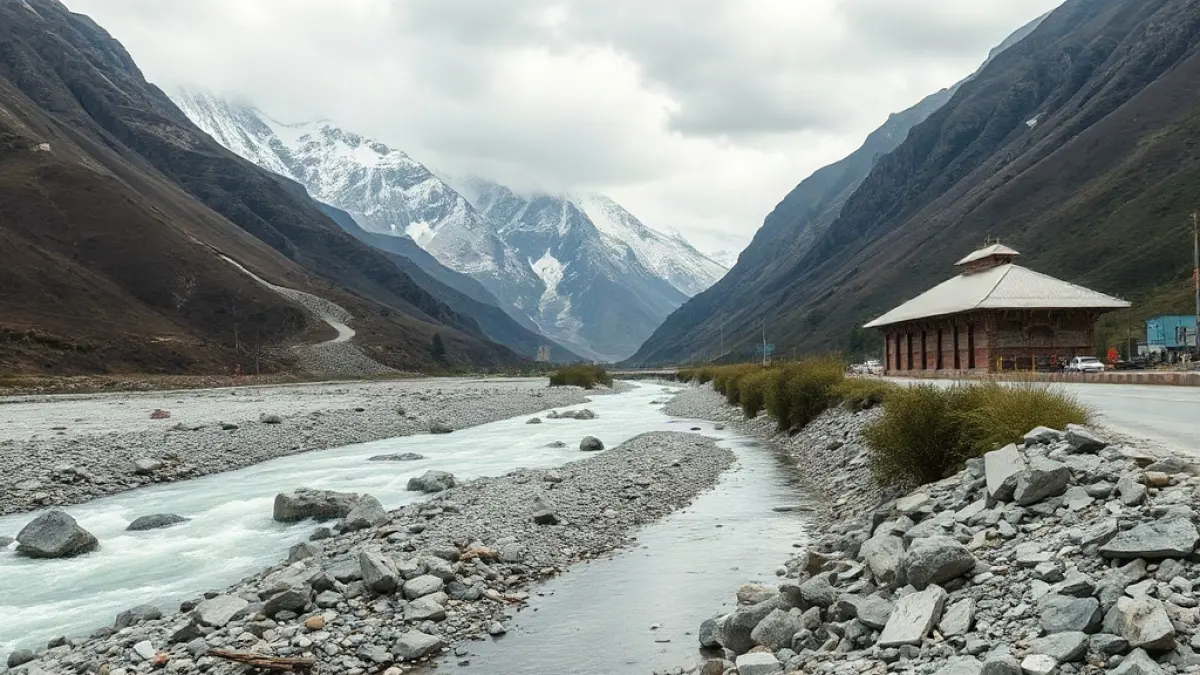
A partial glacier collapse on Langtang Lirung in late August 2026 triggered floods that tore through a key Nepal–Tibet trade and travel corridor, sweeping away the border control gate at Rasuwagadhi–Gyirong and destroying roads and bridges. More than 1,500 people died and some 5,600 remain missing, with rebuilding costs estimated at $4.71 billion.
Key facts
- The collapse occurred in late August 2026 on Langtang Lirung, the highest peak in the Langtang Himal, about 12 miles from the Rasuwagadhi–Gyirong border crossing.
- Flood water reached the border within an estimated seven minutes, moving at over 100 miles per hour.
- The 65-foot border control gate was swept away and carried more than 60 miles downstream along the Trishuli River.
- An estimated 7,500 homes were destroyed in Nepal, together with several bridges and roads.
- Nepal lost just over a tenth of its national grid capacity, around 431 megawatts.
- Rebuilding is estimated at $4.71 billion.
What happened at the border crossing?
Around 400 people were preparing to cross the Rasuwagadhi–Gyirong border on the morning of the collapse. Within an estimated seven minutes of the initial collapse, flood water hit the crossing at over 100 miles per hour, and the 65-foot border control gate was carried more than 60 miles downstream along the Trishuli River.
Roughly 7 billion cubic feet of glacial ice and rock fell thousands of feet into a tributary of the Bhote Koshi River — a mass large enough that the U.S. Geological Survey first recorded it as a magnitude 5.2 earthquake. The floods then raced through the Lhende Khola Valley and into the Bhote Koshi–Trishuli corridor.
Why was there no warning?
Glaciologists initially suspected a glacial lake outburst flood, since Nepal has several thousand glacial lakes and such events are fairly frequent. A World Weather Attribution analysis released in mid-September concluded that years of rising temperatures had thinned the glacier and thawed permafrost in the surrounding bedrock, leaving the slope far more prone to collapse.
Ice-rock avalanches are harder to forecast than lake outbursts. Milind Kudapa, a graduate research assistant at Columbia Climate School, said existing systems "cannot catch rapid micro-scale events like cloud bursts or glacial floods in advance." India and Nepal have roughly five to 10 automated weather stations per 10,000 km², compared with around 120 in Switzerland, where a similar collapse at Blatten in 2025 allowed 300 people to be evacuated nine days ahead. Langtang had no such system, and the flood destroyed warning gauges before they could send an alert.
What damage was done to roads and power?
Fourteen hydropower facilities stood along the 60km corridor. Upper Trishuli 1, a 215-megawatt plant due to finish construction in December, was struck about 16 minutes after the collapse with 1,433 workers inside; over 800 were rescued, while 300 were suspected trapped in access tunnels and the remainder are presumed dead. A July 2025 outburst flood in the same corridor killed nine people and damaged several of the same projects; the Rasuwagadhi plant rebuilt afterwards was destroyed again in August.
What this means for travellers
The Rasuwagadhi–Gyirong border crossing lost its control gate, and roads and bridges along the corridor were destroyed. The source does not state the current status of the crossing or when it will reopen. Anyone planning to use this route should check the latest position of the crossing and road conditions before travelling.
What happens next
How long rebuilding will take — and how much of it will happen at all — remains to be seen. Ram Prasad Dhital, chairman of Nepal's Electricity Regulatory Commission, has argued that hydropower construction standards must rise nationally, with electricity expected to become at least 10–12% costlier.
Also about:  China
 India
 Bangladesh