
 ZimbabwePassports
Zimbabwe Passport Fees of $170 Challenged by Opposition Figure
National Progressive Democrats chairperson Tendai Kabasa has questioned how Zimbabwe's $170 ordinary passport fee is divided, saying the money goes to a bank, a Lithuanian company and government. He says an ordinary passport costs only a few dollars to produce.
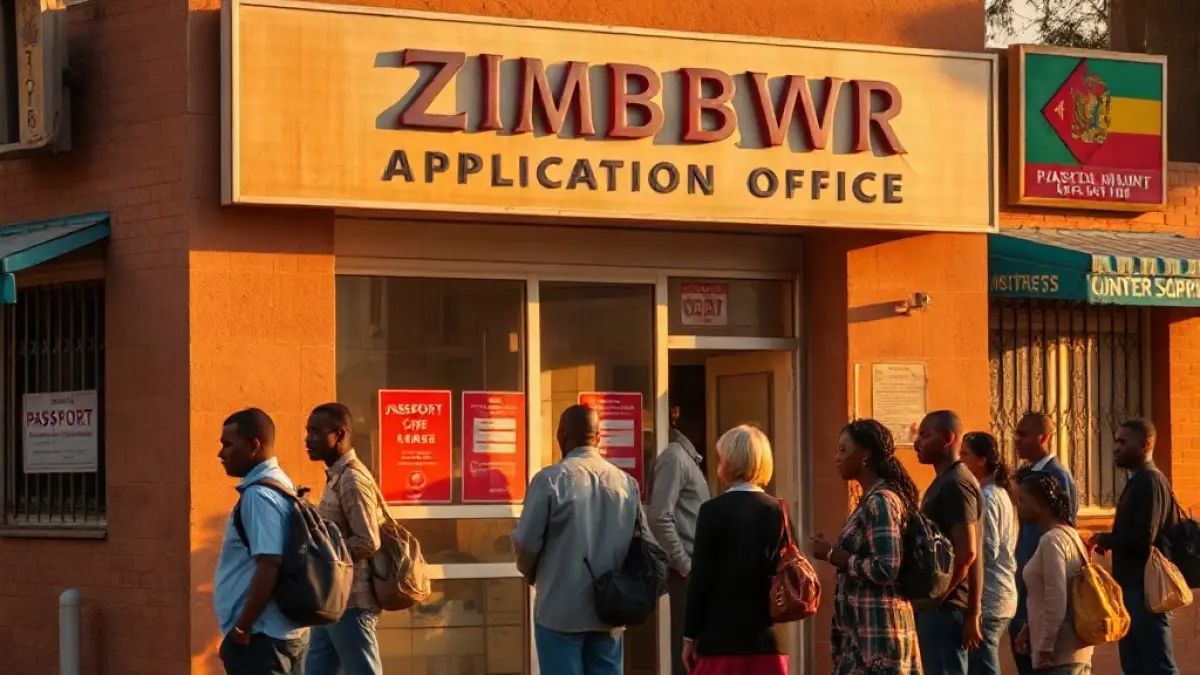
Zimbabweans applying for a passport pay $170 for an ordinary document, and an opposition figure is challenging how that money is split. Tendai Kabasa, chairperson of the National Progressive Democrats, set out the figures in a statement on Monday and described the arrangement as a private tax on citizens.
Kabasa's criticism targets the passport pricing structure, CBZ Bank's role in collecting payments and the contract held by a Lithuanian document company. No government response is included in the material reviewed.
Key facts
- Published price: $150 for an ordinary passport plus a $20 QR fee, totalling $170
- An emergency passport is charged at $270
- CBZ Bank collects $20 per applicant
- Garsu Pasaulis is estimated to take $60 to $80 per passport, with government receiving $50 to $70
- The passport facility has capacity for 30,000 passports per day
What does a Zimbabwe passport cost?
The published structure is $150 for an ordinary passport plus a $20 QR fee, bringing the total to $170. An emergency passport is charged at $270.
According to the cost breakdown accompanying the statement, the real cost to produce an ICAO-compliant e-passport booklet globally is between $8 and $12. That figure covers a blank booklet plus chip at $4 to $8 in bulk, personalisation and printing at $2 to $3, and $1 for system and factory amortisation. Kabasa separately claimed a passport costs about $5 to produce and $3 to print.
The breakdown states that of the $150 charged, 90% is rent and 10% is real cost.
Who is collecting the money?
Kabasa said CBZ Bank collects $20 from every applicant. He also pointed to Garsu Pasaulis, a Lithuanian company, which he said takes an estimated $60 to $80 per passport.
The contract with Garsu was awarded without tender under a Build-Own-Operate-Transfer (BOOT) arrangement, in which the company builds the facility and recovers its capital through a fee per booklet. Garsu is described as a Lithuanian subsidiary of Belgian company Semlex, owned by Albert Karaziwan. The statement says Semlex has been investigated in Belgium, Comoros and Kyrgyzstan for bribing officials to win passport tenders.
Zimbabwe has never published the revenue share, according to the statement. It says the model used in the Democratic Republic of the Congo, Madagascar and Cameroon shows Semlex keeps $50 to $100 per passport, and that in the DRC the company raised the price from $100 to $185 and kept $85.
How does this compare with other countries?
The statement describes Zimbabwe as having the most expensive passport in the Southern African Development Community (SADC). It lists Botswana at $25, South Africa at $33 and Zambia at $28 for express issuance, against Zimbabwe's $170 ordinary and $270 emergency fees.
Why are prices so high?
Kabasa accused the Registrar General's office of slowing down passport production to justify the prices. He also said the Auditor-General reported in 2022 that it could not verify where the US dollars went after CBZ collected them. In his words, "It is rent collection, not document production."
What this means for travellers
Anyone applying for a Zimbabwean passport should budget for the published total of $170 for an ordinary document or $270 for an emergency one. The allegations raised concern the way fees are divided rather than any announced change to application procedures, and no rule change is stated in the material reviewed.
Kabasa called for the Auditor-General's office to refer the matter to police. No official review, deadline or further decision has been announced.
Also about:  Lithuania
 Belgium
 Comoros
 Kyrgyzstan
 DR Congo
 Madagascar
 Cameroon