
 ColombiaTravel
Bomb at Colombia tax office beside Cucuta border bridge wounds 4 police
A bomb outside Colombia's tax agency office near the Francisco de Paula de Santander International bridge in Cucuta injured at least four police officers on 27 October 2026. Police are investigating who carried out the attack.
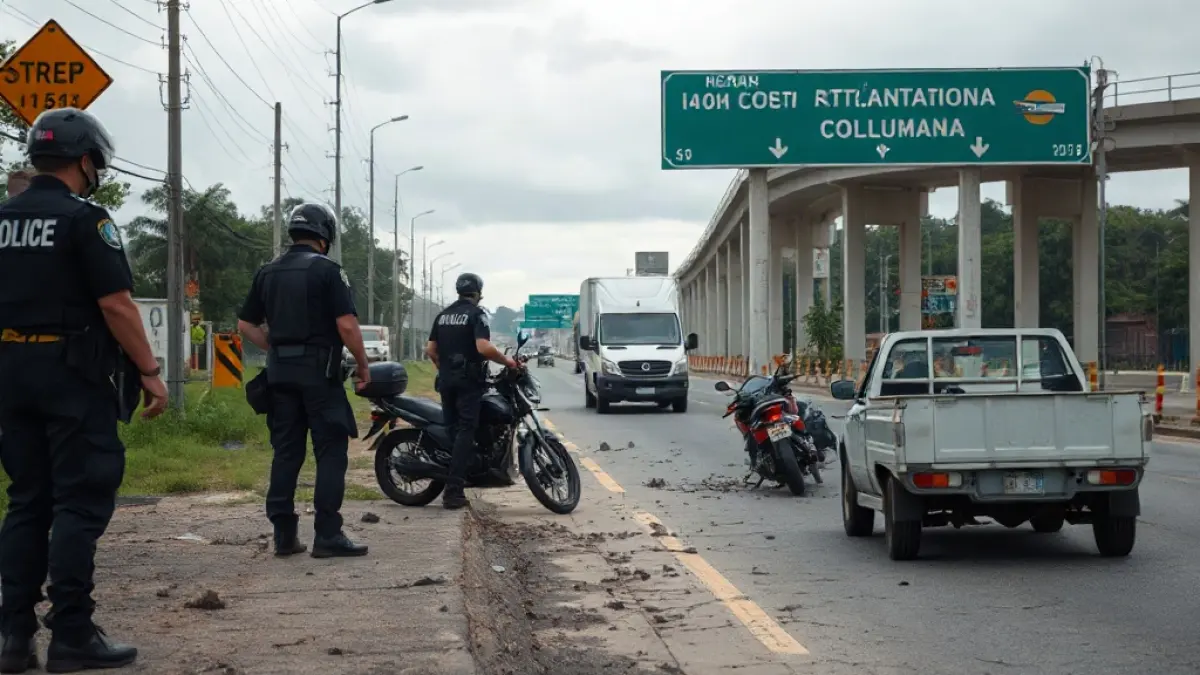
A bomb exploded on Tuesday, 27 October 2026, beside an international bridge linking Colombia and Venezuela, injuring at least four police officers in the border city of Cucuta. The device went off in front of the local branch of Colombia's tax collection agency, near the Francisco de Paula de Santander International bridge.
Key facts
- Date: Tuesday, 27 October 2026
- Location: outside Colombia's tax agency office near the Francisco de Paula de Santander International bridge, Cucuta
- Casualties: at least four police officers injured
- Damage: a truck and several motorcycles were damaged
- Investigation: police are examining who was responsible, according to Norte de Santander provincial Gov. William Villamizar
What happened?
The explosion struck the area in front of the tax agency's local office, close to the bridge that crosses into Venezuela. Footage of the aftermath showed a truck and several motorcycles damaged by the blast.
Norte de Santander provincial Gov. William Villamizar said on social media that police were investigating who was responsible for the attack. Officials did not name a suspect or say whether any group had claimed responsibility.
What else has happened in Cucuta recently?
Authorities in Cucuta are also investigating the killing of a former deputy mayor, who was assassinated on Monday night on his way home. In September, an attack on another police station in the border city killed a civilian and injured 11.
ACLED, a think tank that monitors conflicts worldwide, recorded 34 attacks using bombs or explosives in Colombia in a four-week period that ended on 16 October — a 9% increase on last year's four-week average.
Why is violence increasing?
Colombia's conservative government has shifted its security strategy since President Abelardo de la Espriella was sworn into office in August. He canceled peace talks with the nation's remaining rebel groups, alleging that negotiations had yielded few results over four years and that armed groups had used ceasefires to strengthen their grip on rural areas.
De la Espriella, nicknamed "the Tiger," has reestablished joint task forces to protect oil pipelines and has promised to tackle the cocaine trade by spraying coca fields with herbicides, a practice suspended in 2015 over health concerns. Early on Tuesday he supervised a gang operation in Medellin in which the government said 135 suspects accused of trafficking people and drugs were captured; in a video from his office, he told one suspect, "The party is over." Critics say he uses law enforcement operations for propaganda and doubt the armed forces can disarm rebel groups by force alone without returning to talks.
What this means for travellers
The blast occurred beside an international crossing used for travel between Colombia and Venezuela. The source reports no changes to border procedures, entry rules or travel documents as a result of the attack. Travellers using the Francisco de Paula de Santander International bridge or visiting Cucuta should follow instructions from local authorities and monitor official notices.
Police continue to investigate who was responsible for the Cucuta bombing. No suspect has been named, and officials have not announced further measures at the border.
Also about:  Venezuela